HABITUSSekizgen Academy
Sekizgen Academy · Software · v2.1.0

HABITUS

A desktop application for species distribution modelling, no coding required

HABITUS takes the coordinates where a species occurs and a set of environmental raster layers, builds a habitat suitability model, tests it with spatial cross-validation, produces maps for the present and future climate, computes the range change between two maps and gathers every step into a single HTML report. All computation runs in Python; no R installation is needed.

18algorithms
8cross-validation designs
3operating systems
GPL-3free software
HABITUS ③ Models + Current MapHabitat Analysis & Biodiversity Integrated Toolkit for USDM
Workflow

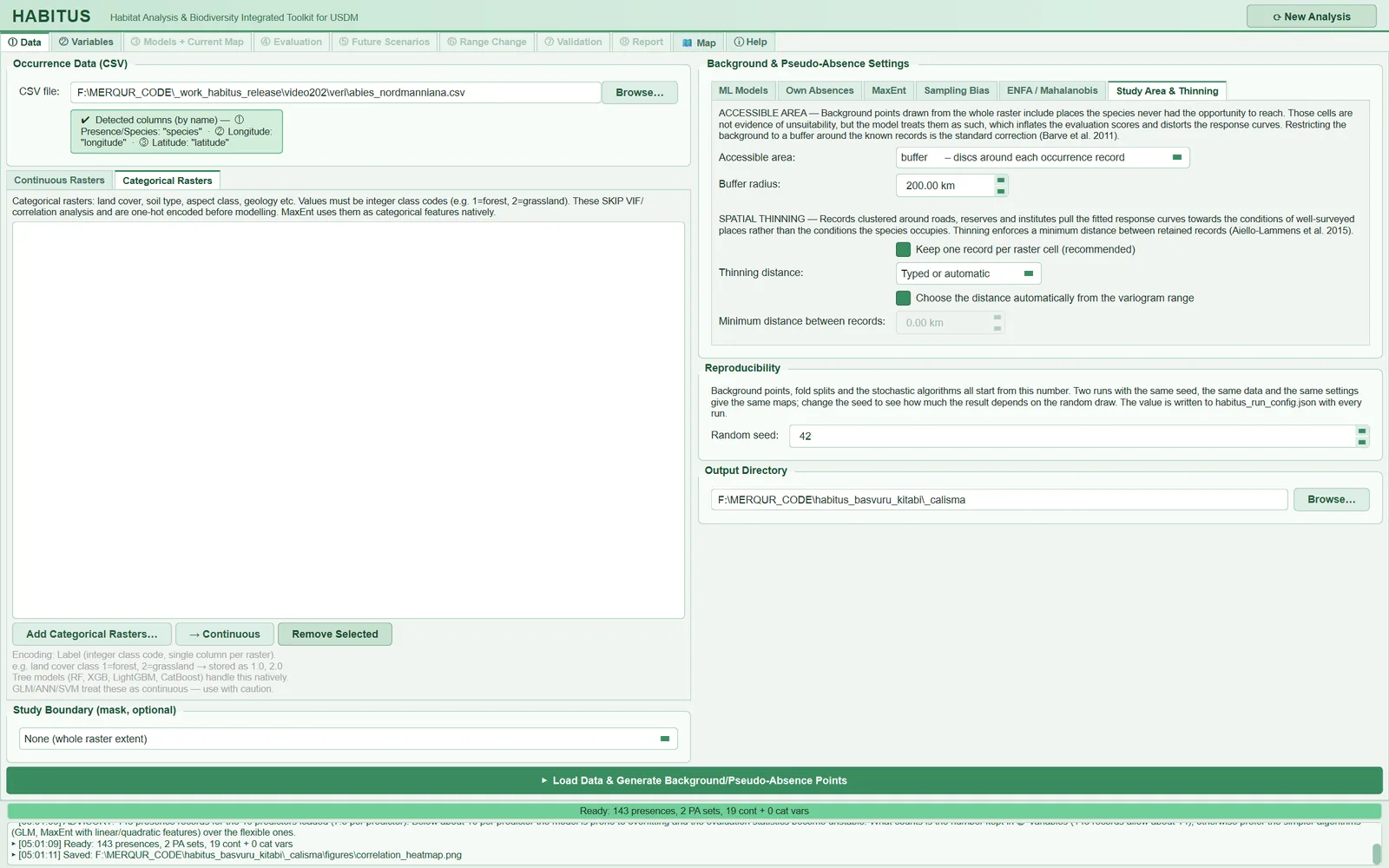
The tabs unlock in order; each step uses the output of the previous one.

  1. Records and layers
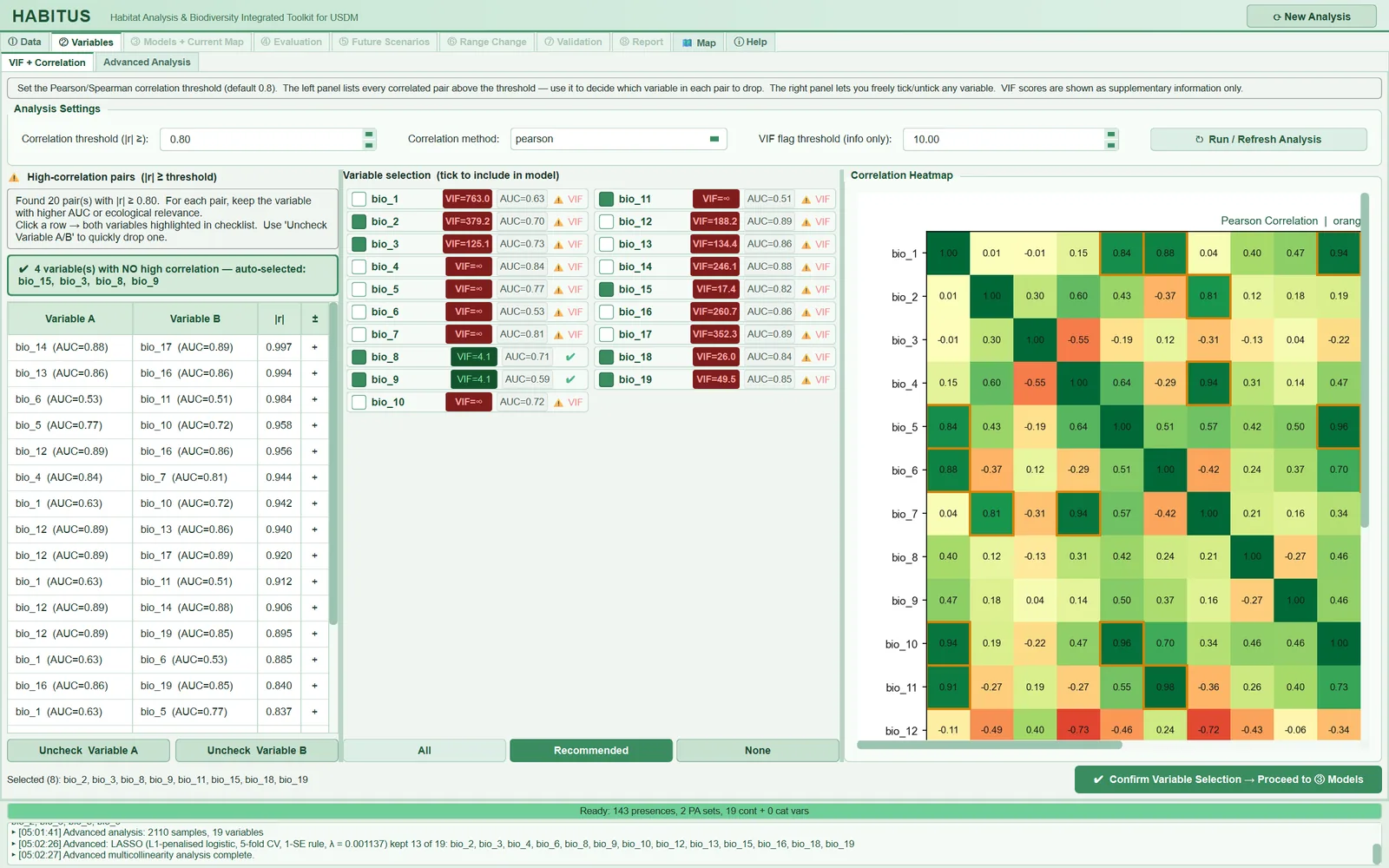
  2. Variable selection
  3. Models and current map
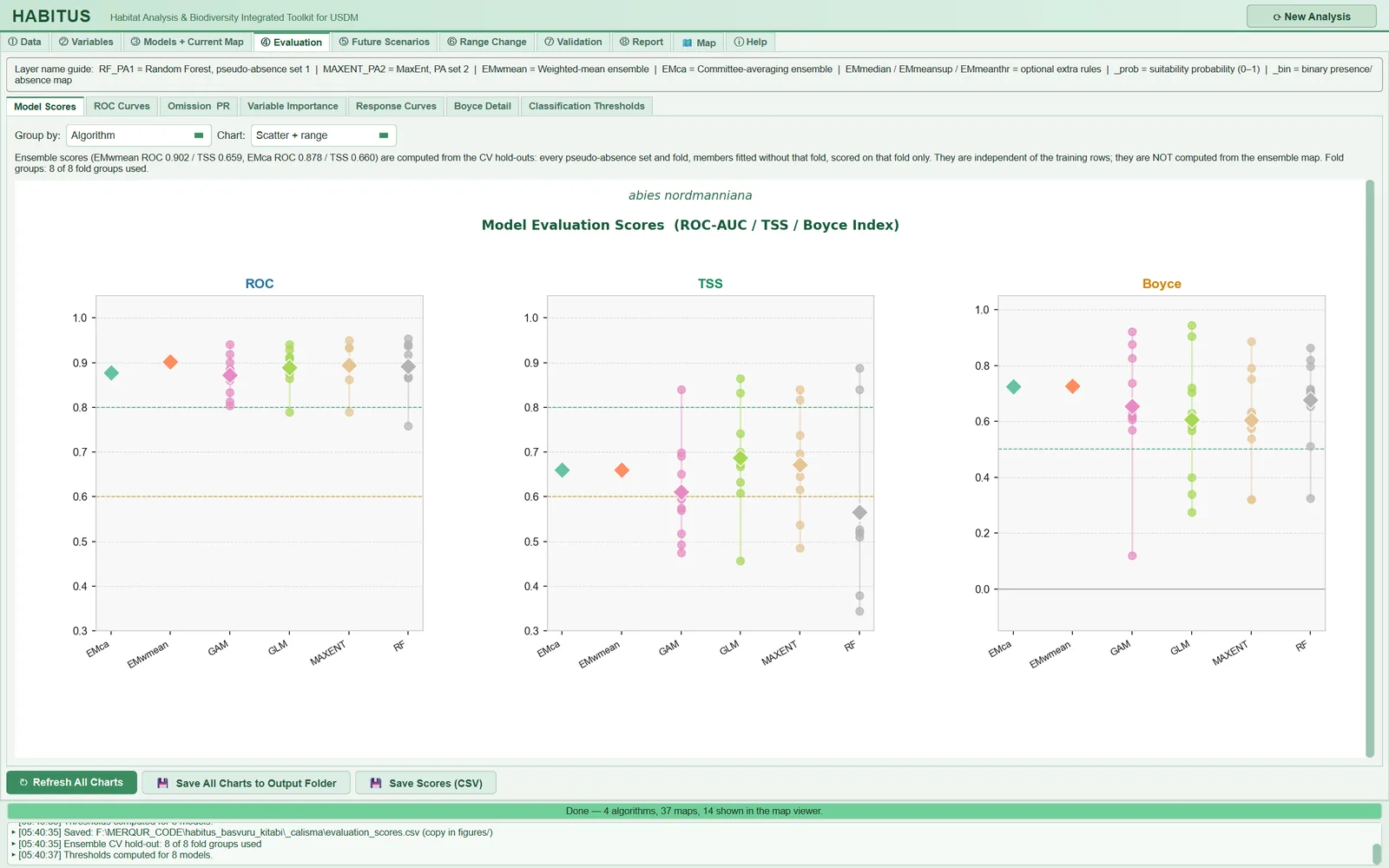
  4. Evaluation
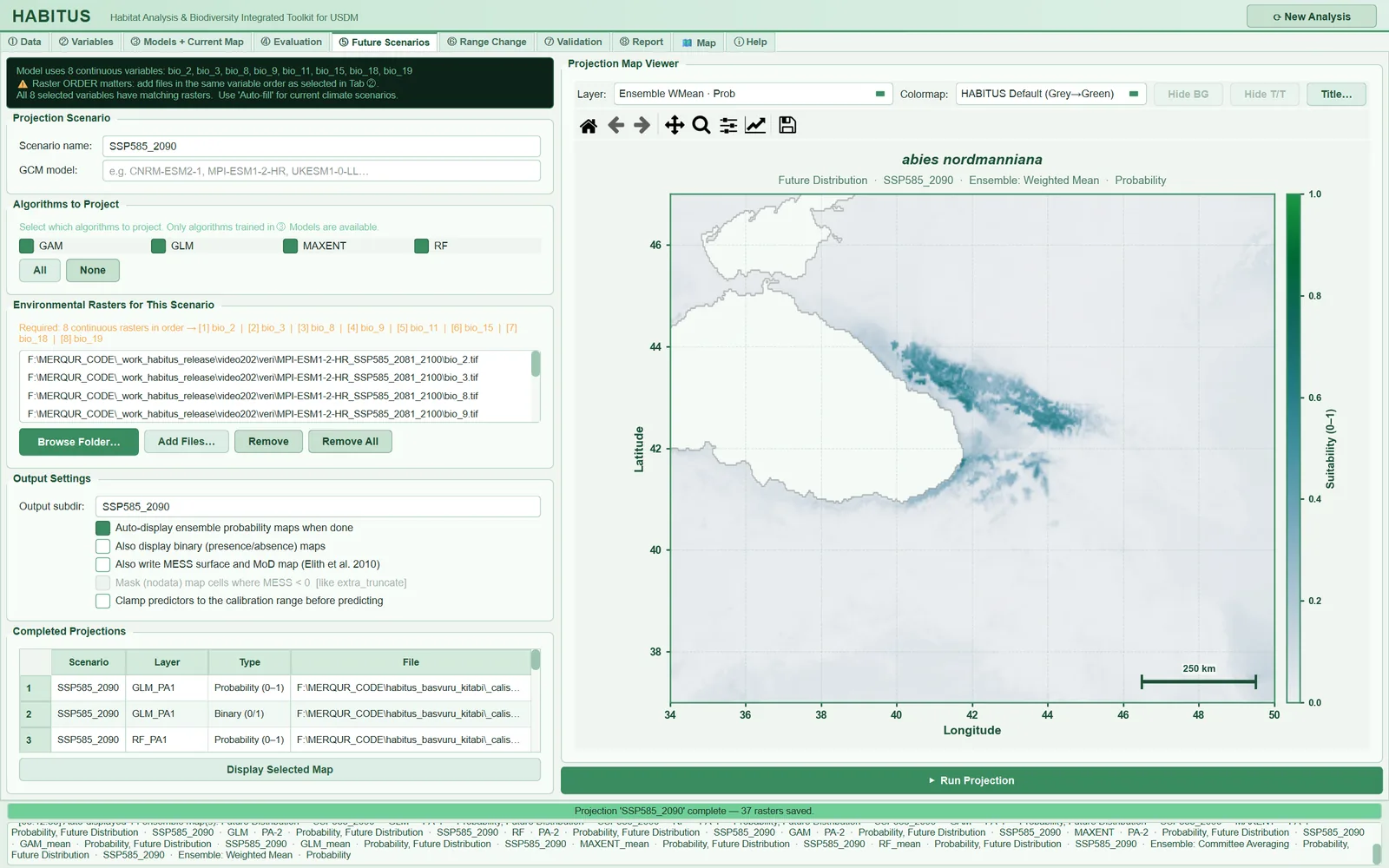
  5. Future scenarios
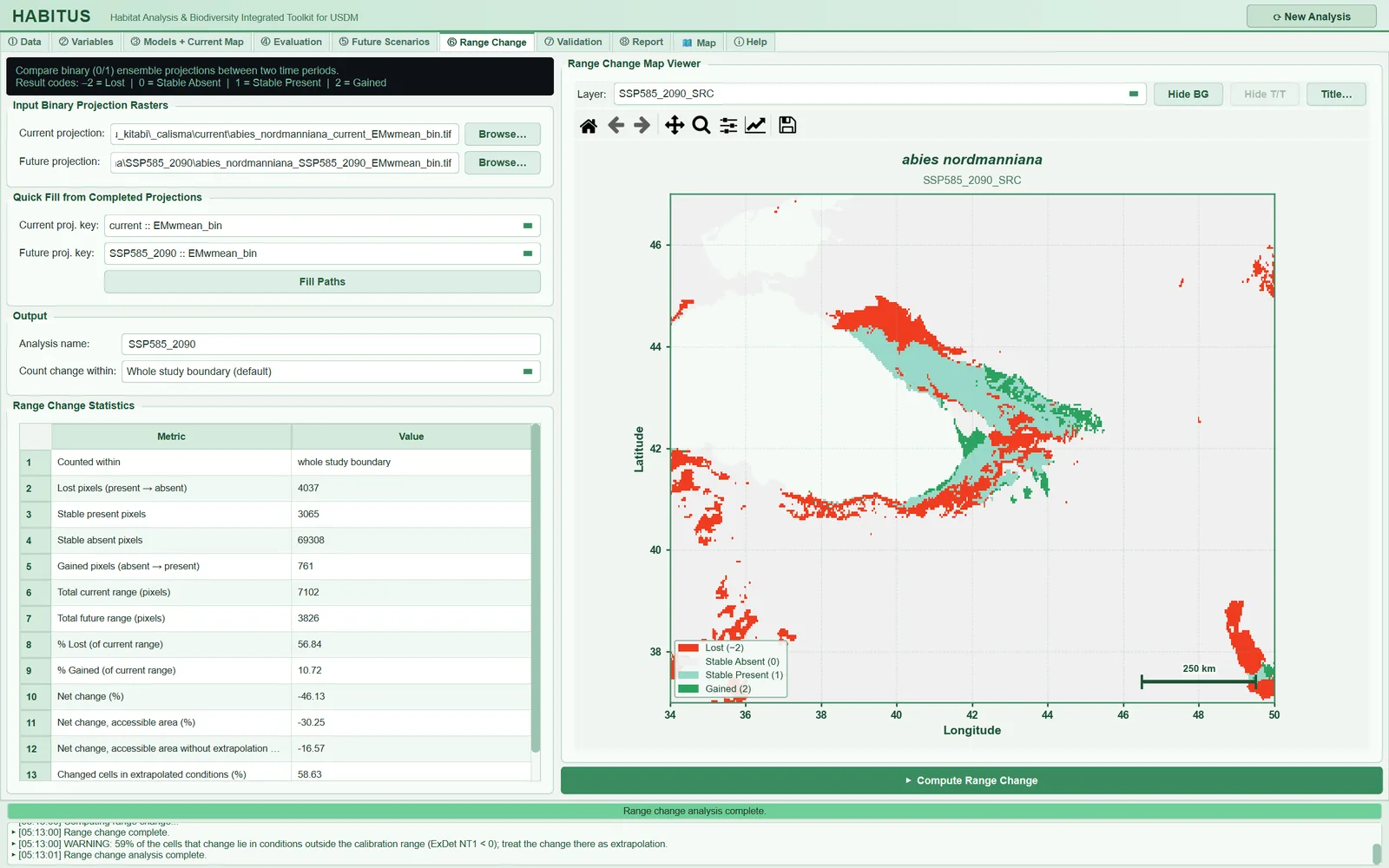
  6. Range change
  7. Independent validation
  8. Report

Screens

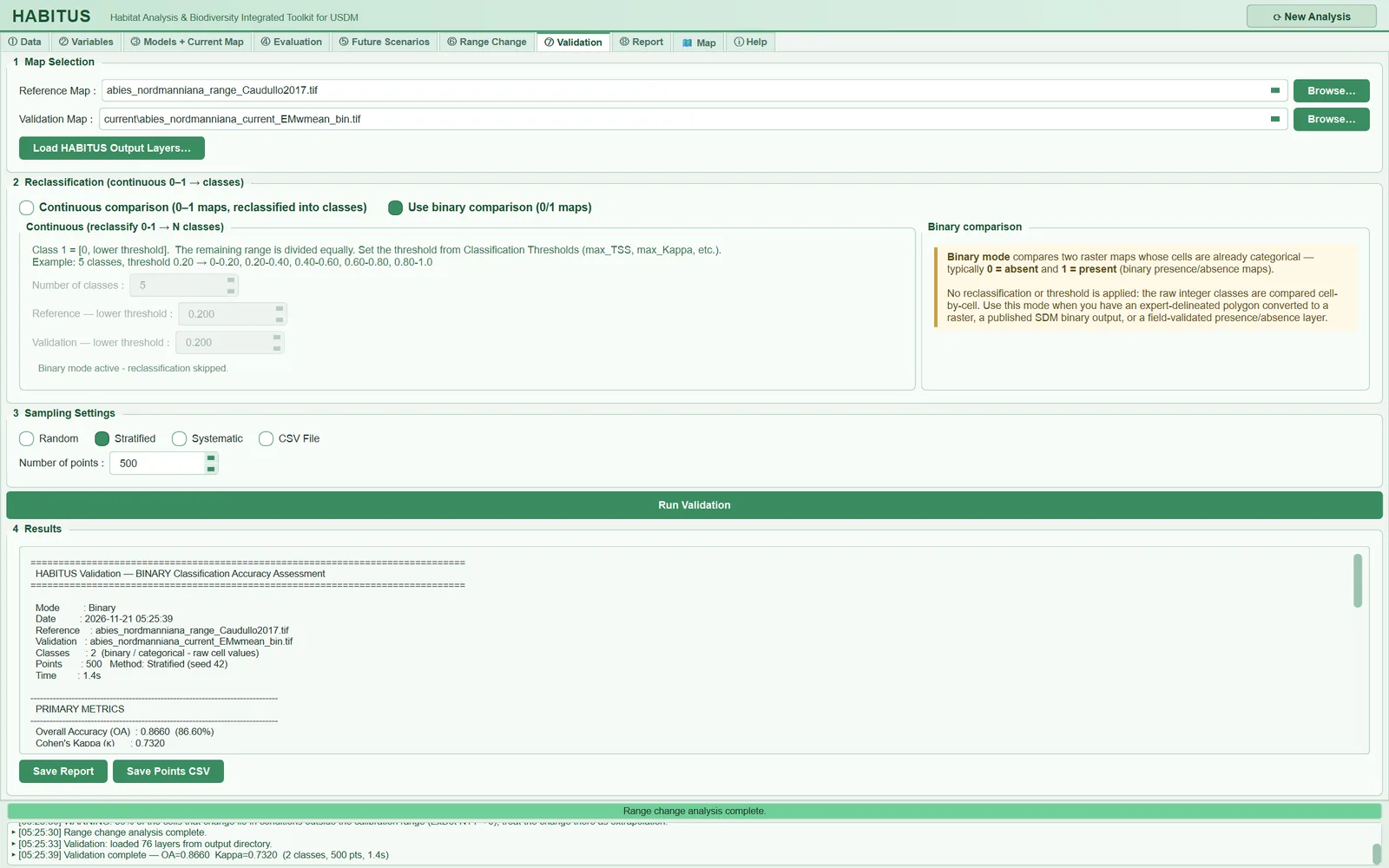
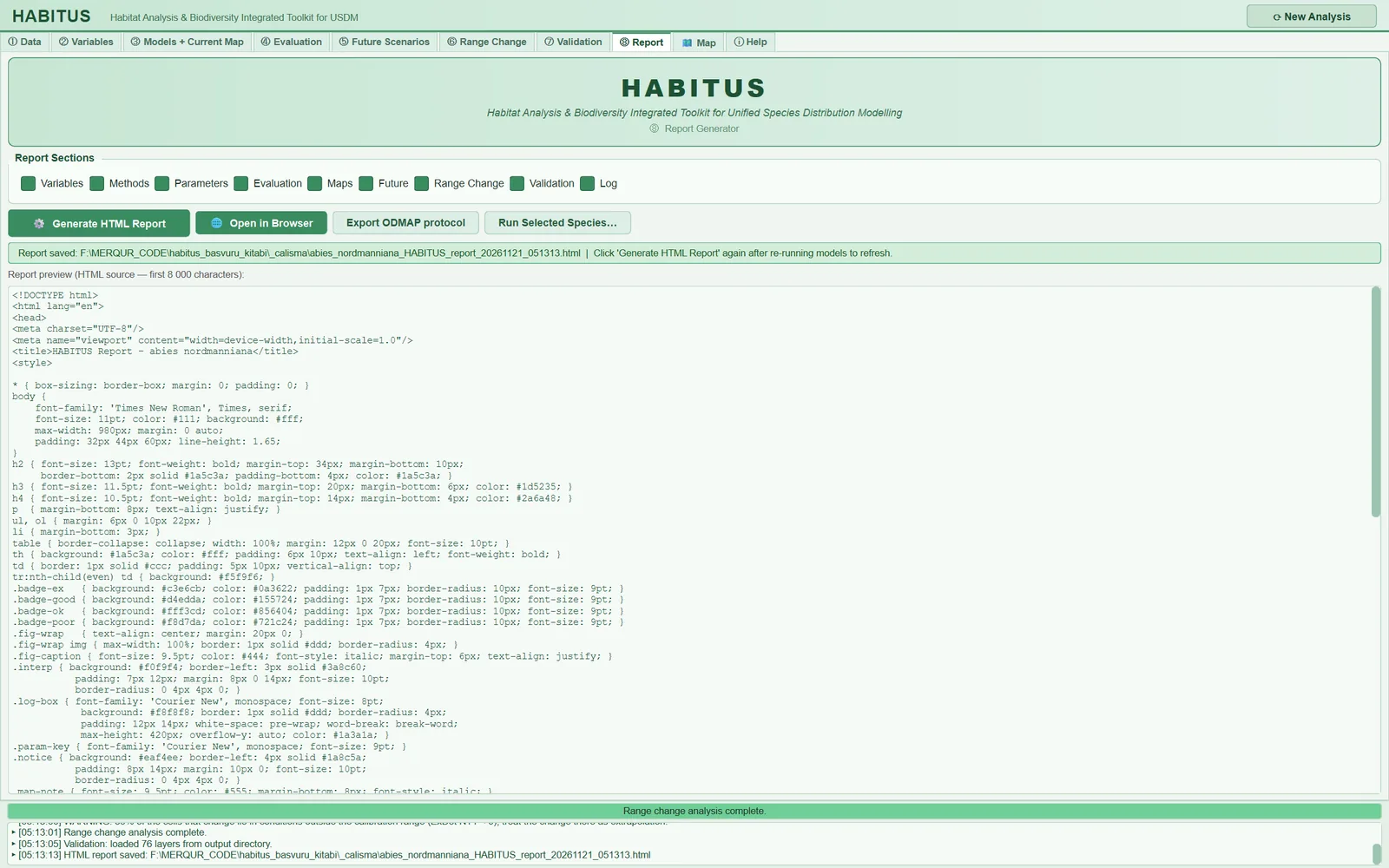
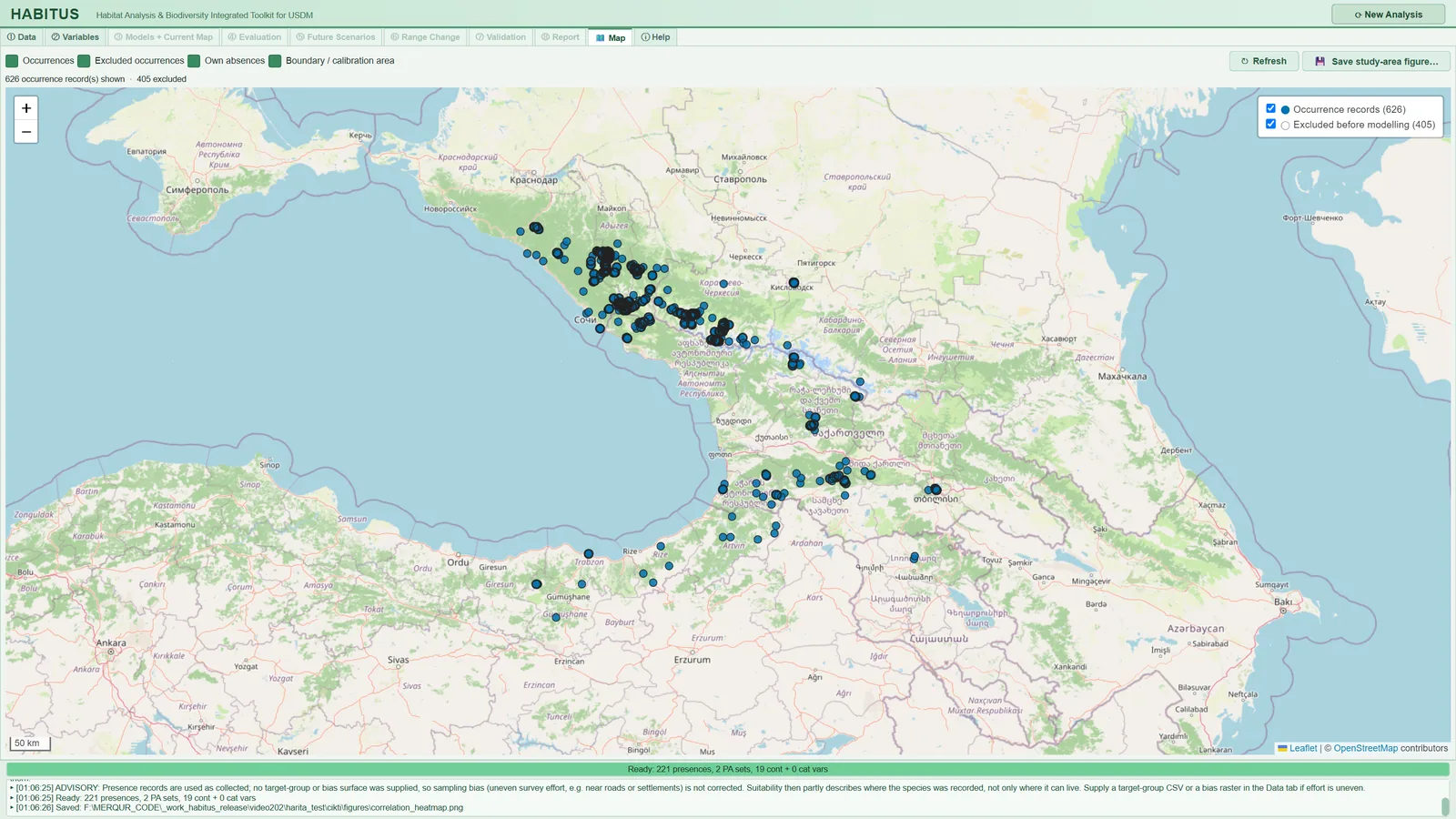
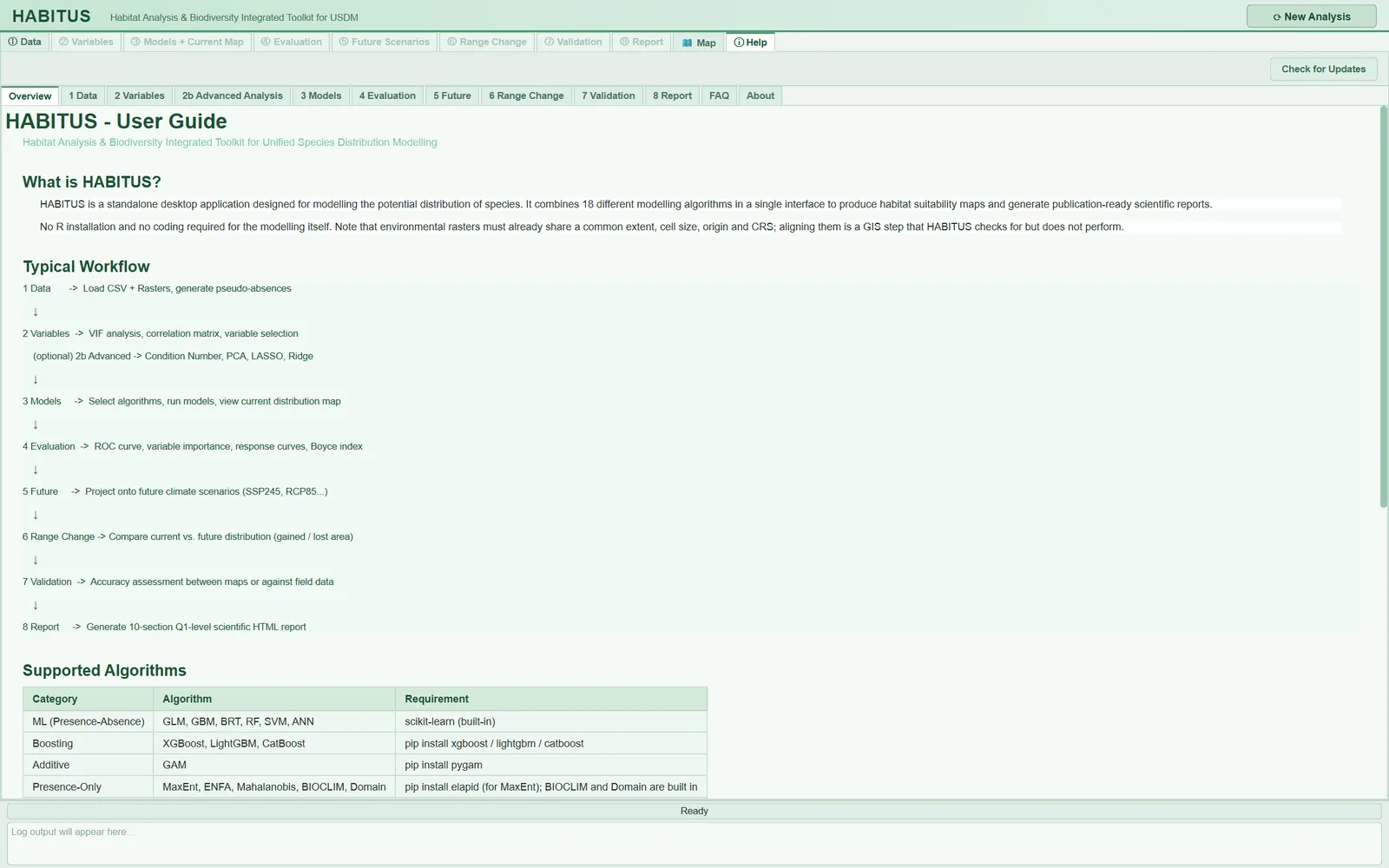
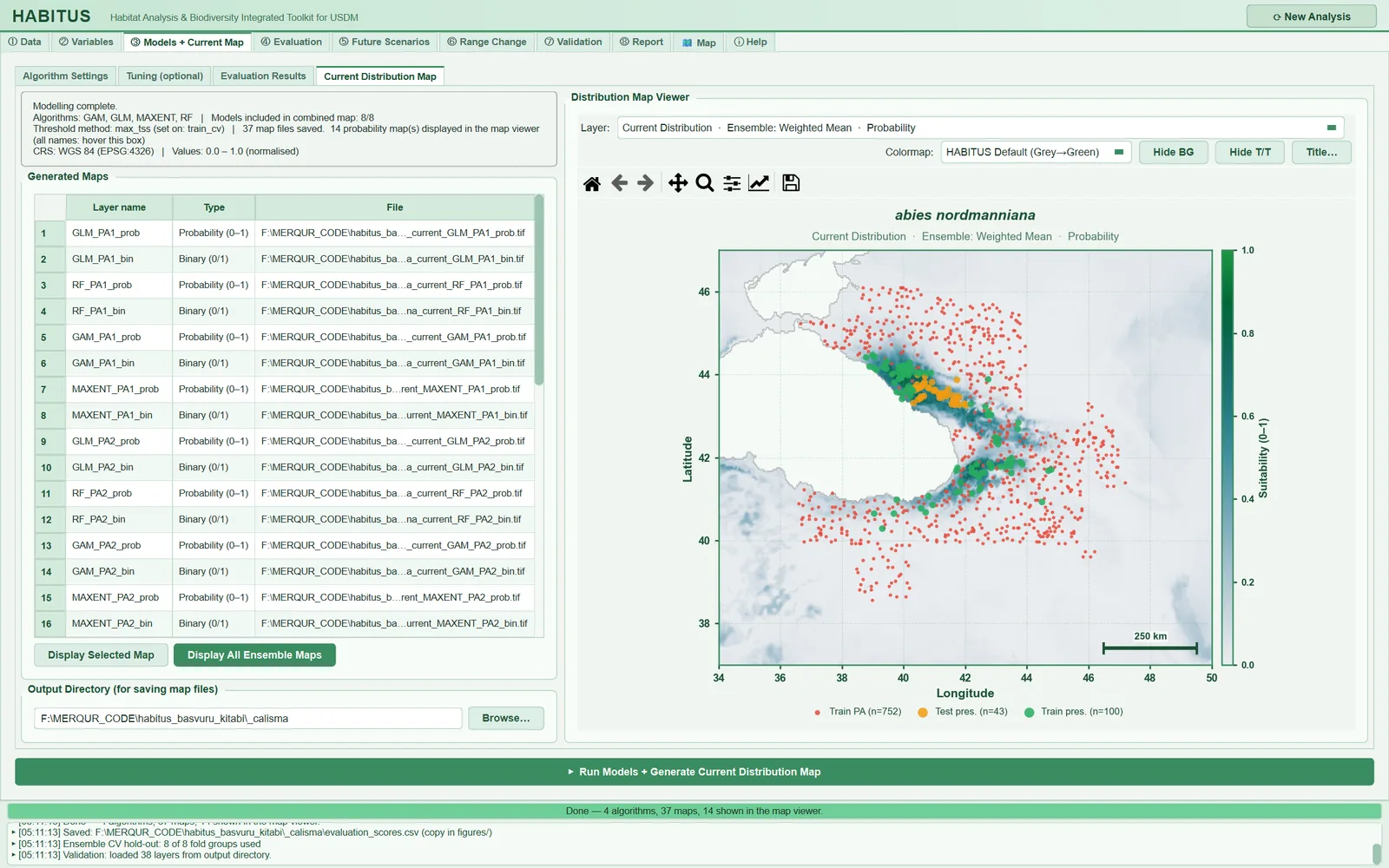
The window below is the program itself: click the tabs. The screenshots come from a sample run (Abies nordmanniana, 626 records, WorldClim 2.1; GLM, GAM, RF, MaxEnt).

HABITUSHabitat Analysis & Biodiversity Integrated Toolkit for USDM⟳ New Analysis
③ Models + Current Map: 18 algorithms, cross-validation, threshold and ensemble

18 algorithms, cross-validation, threshold and ensemble

③ Models + Current Map

  • GLM, GAM, RF, GBM, BRT, XGBoost, LightGBM, CatBoost, SVM, ANN, GLMNET, CART, MaxEnt, ENFA, Mahalanobis, BIOCLIM, DOMAIN and ESM, each with its own settings page.
  • Eight cross-validation designs: spatial block (default), environmental, random, two checkerboards, jackknife, longitude and latitude bands.
  • Five threshold methods; ensemble maps with weighting, member selection and uncertainty maps.
  • Optional tuning search and a viewer for the current distribution map.
In the Reference Book
Chapter 5Chapter 6
v2.1.0

Reference Book

Describes every screen and every parameter: what it does, how to set it and how it affects the results. Every default and behaviour is taken from the source code and cited as file:line. Each chapter ends with expert questions at reviewer and examiner level.

Turkish · HABITUS 2.1.0

HABITUS Başvuru Kitabı

Seda ÖRÜCÜ & Ömer K. ÖRÜCÜ
217 pages
Read HTMLDownload PDF ↓
English · HABITUS 2.1.0

HABITUS Reference Book

Seda ÖRÜCÜ & Ömer K. ÖRÜCÜ
230 pages
Read HTMLDownload PDF ↓
  1. 1 Introduction and workflow
  2. 2 Data I: records, layers and study boundary (① Data)
  3. 3 Data II: background, pseudo-absences, accessible area and thinning (① Data)
  4. 4 Variables (② Variables)
  5. 5 Models I: algorithms and their settings (③ Models → Algorithm Settings)
  6. 6 Models II: cross-validation, threshold, ensemble and results (③ Models)
  7. 7 Evaluation (④ Evaluation)
  8. 8 Future scenarios (⑤ Future Scenarios)
  9. 9 Range change (⑥ Range Change)
  10. 10 Independent validation (⑦ Validation)
  11. 11 Report, ODMAP and multi-species runs (⑧ Report)
  12. 12 Map, Help and output files (🗺 Map, ⓘ Help)

Download

Installers are published on the GitHub release page. The Windows builds are signed with an Authenticode certificate issued to the developer.

PlatformFileDescription
WindowsHABITUS_Setup_v2.1.0.exeInstaller (recommended)
WindowsHABITUS_v2.1.0_Windows_x64_portable.zipPortable; unzip and run HABITUS.exe
LinuxHABITUS_v2.1.0_x86_64.AppImagePortable; make it executable with chmod +x
LinuxHABITUS_Setup_v2.1.0_Linux_x64.tar.gzArchive; extract and run
macOS (Apple Silicon)HABITUS_Setup_v2.0.2_macOS_arm64.dmgM1 and later (2.0.2; the 2.1.0 disk images follow)
macOS (Intel)HABITUS_Setup_v2.0.2_macOS_x86_64.dmgIntel Macs (2.0.2; the 2.1.0 disk images follow)
Allhabitus_sample.zipSample data: Pinus brutia, 108 records, 23 predictors

Requirements: Windows 10/11 64-bit · macOS 14 (Apple Silicon) / 15 (Intel) · Linux glibc 2.35 or later (Ubuntu 22.04+) · 8 GB RAM recommended for high-resolution rasters. · All releases

Citation

If HABITUS contributes to a publication, please cite:

Örücü, Ö. K., & Örücü, S. (2026). HABITUS: Habitat Analysis and Biodiversity Integrated Toolkit for Unified Species Distribution Modelling. Ecological Perspective, [Technical Report]. https://doi.org/10.53463/ecopers.20260435

Licence

HABITUS is free software distributed under the GNU General Public License, version 3 (GPL-3.0). The corresponding source code is provided on request. The bundled third-party libraries keep their own licences.

Development: Seda ÖRÜCÜ & Ömer K. ÖRÜCÜ